San Rufino: il santo e la chiesa
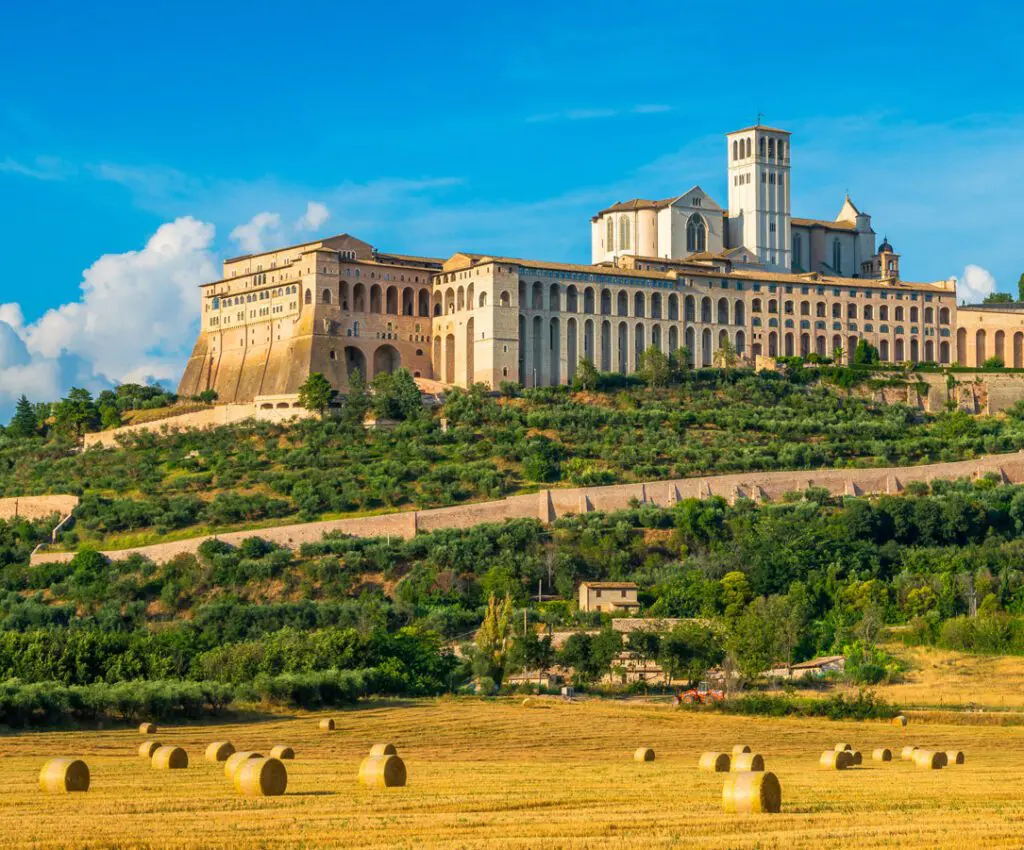
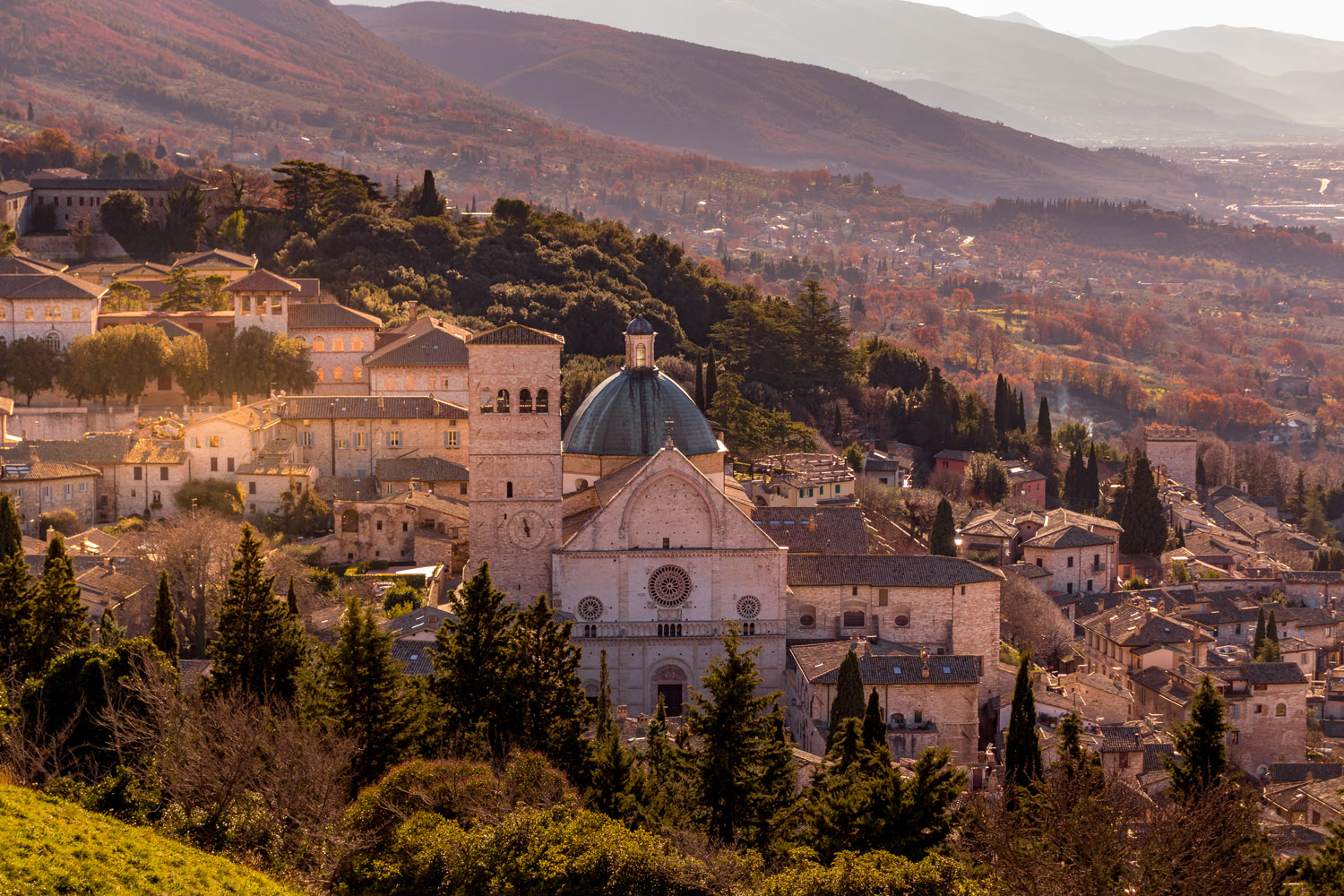
Many think that the Basilica of Saint Francis is also the Assisi, cathedral, but it is actually not: Assisi's “mother church” can be found on the opposite side of the town, the oldest one. And, it is dedicated to Saint Rufinus, Assisi's first bishop as well as its patron saint. The sources with details about his life are a sermon written by San Pier Damian, in the years 1052-1060 (Miracula Sancti Rufini Martyris, Sermon 36), and a Passio Sancti Rufini of the 14th century.
Rufinus' story begins in the Near East, more precisely in an area belonging to current Turkey. From his homeland, he reached Italy together with his son in order to proclaim the Gospel in an epoch – the third century AD – that was of persecution against Christians. To Assisi, Rufinus brought the message of Christianity up to giving his own life for Christ's sake on August 11, 238. He was arrested, tortured, killed by decision of the Roman proconsul in the town, Aspasius. A heavy stone having been hung at Rufinus' neck, he was thrown into Chiascio River. His body was then retrieved, and buried in the same area in which he had been found. Later on, between the eighth and ninth centuries, Rufinus' remains were moved to a small church dedicated to him, then mentioned as parva basilica, “a small basilica.”
The Church
Rufinus – one might say, a forerunner of Saint Francis –brought Christian faith to the town and first founded the Church of Assisi. This is why the most important church, the cathedral, is entitled to him. So, the Saint's life is strongly connected with the town history and with this building, which was remade in the early decades of the 11th century by decision of the then bishop, Hugo. In 1140 “Master John from Gubbio" was officially entrusted with the project of a bigger church, as stated by a stone plaque walled in a room near the sacristy. Just, because of the political conflicts revolving about the power of the Emperor, followed by clashes within Assisi, the building of the cathedral had to be carried on for more than a century. San Francis (who died in 1226), in fact, would not see the church after its completion: it would be consecrated only in 1253 by Pope Innocent IV.
Starting from the most ancient witness of Rufinus, Christian faith reached Francis, who would often preach in the square in front of the church then under construction, and become a witness of Christ in his turn. Precisely here, Francis was listened to by Clare, who decided to become one of his followers.
A Masterpiece of Romanesque Art in Umbria
Saint Rufinus' façade
The Cathedral of Saint Rufinus is embellished by a façade that provides one of the most meaningful examples of Umbrian Romanesque – a masterpiece that can stand the comparison with the façade of the Spoleto Cathedral. belonging to the same period. The wall is divided in three major areas, both horizontal and vertical, marked by high half pilasters. In its turn, the lowest level is divided into squares and articulated by three decorated gates: a bigger one in the middle and two lesser ones on both sides. On top of both lesser gates are lunettes with pair of animals (two birds on the right, two lions on the left) drinking at a spring. The main entrance is “guarded” by the sculptures of a lion devouring a man, and a griffin with a prey in its talons. The main gate is richly decorated with geometrical patterns, twines, and vine shoots, swarming with animals both real and imaginary, flowers and fruits. Its lunette shows in its middle a clipeus that encloses the enthroned King Jesus between the sun and the moon; on the left, Virgin Mary who breastfeeds her Child; on the right, Saint Rufinus in his garments as a bishop. A low exterior gallery marks the boundary with the middle area of the façade, where three rose windows can be seen. The central and biggest one is surrounded by the Four Living Beings, the symbols of the Evangelists. The window is apparently supported by three male figures, called “telamons,” who stand on the backs of animals. On closer inspection, the left rose window too is decorated by sculptures: in the circle center, Archangel Michael pierces the dragon with his spear, while on both sides two figures “hold” the window itself.
The Symbols on the Cathedral Façade
It is worth noticing how many times the symbolic number 3 appears on the façade:
- both horizontal and vertical areas
- 3 gates
- 3 lunettes
- 3 rose windows
- 3 telamons
Three, the symbol of Holy Trinity as well as the perfect number par excellence, is anyway not the only symbol on the façade of the Assisi Cathedral. Details abound, and the very many sculptures – to be personally admired and discovered – convey one overall symbolic meaning: they are not mere decorations, just for the sake of it. The message implied in Romanesque sculpture could be easily read by Christians in the 12th and 13th centuries. As time went by, however, that meaning was lost, so that it is only possible to make conjectures nowadays. We can glimpse the fight between Good and Evil, the praise of town harmony and the refusal of violence, the Incarnation of God's Word and the Last Judgment. According to scholars, moreover, the message written in those stones makes reference to historical and political events of that time.
The authors of this important figurative display have remained unknown. The sculptures have been ascribed to the laboratory of some Rodolfo and Binello, who also worked in Bevagna.
The interior, and the “tug of war”
Inside, the Cathedral of Saint Rufinus exhibits a late Renaissance style insofar as it was completely remade by Galeazzo Alessi, an architect from Perugia, in the years between 1571 and 1585. He also worked on the Basilica of Saint Mary of Angels and the Della Corgna Palace. The room is divided in three naves. The apse includes a precious wood choir of 1520, wholly engraved by Master Giovanni di Piergiacomo da San Severino. In 1663, Giacomo Giorgetti (1603 - 1679), a painter from Assisi, decorated the Chapel of the Blessed Sacrament, a treasure chest of Baroque art in the heart of Assisi. As tradition runs, the baptismal font is the very one that was used to baptize both Saint Francis and Saint Clare – the personages being represented in two 19th century statues by a female artist, Amalia Dupré.
In the above-mentioned sermon, Saint Peter Damian also recalls a curious fact about a dispute on the place where Saint Rufinus had to be buried. There had been a contrast between the bishop, Hugo, who meant to transfer the body to a different church, and the people of Assisi. So, according to a tradition, a “tug of war” was arranged, using the coffin of the Saint as a rope; and the people's men won. From then on, his remains do remain in the Cathedral.
INFORMAZIONI
Località
Piazza Cahen, 5B, 05018 Orvieto TR
Orari
Giugno-Agosto: tutti i giorni 9:00-20:00
1-22 Settembre: tutti i giorni 9:00-19:00
5-11 Ottobre: tutti i giorni 9:00-19:00
12-19 Ottobre chiuso per lavori di manutenzione.
Dal 20 ottobre: tutti i giorni dalle 9:00-19:00
La biglietteria chiude 45 minuti prima dell’orario di chiusura.
Contatti
Email: info@genesiagency.it