
The celebration of the fifth centennial of Perugino’s death – the “divine painter”’s – has gotten into the thick of things by now. In Perugia, in early March, the exhibition Il meglio maestro d’Italia. Perugino nel suo tempo (“The best master all over Italy: Perugino in his own times”) was inaugurated, that will remain open until June 11, 2023. It is held inside the National Gallery of Umbria in Corso Vannucci, Perugia’s main street, named precisely after him since Pietro Vannucci was his real name.
The collaboration between the National Gallery of Umbria and the “St. Lawrence Island”
The exhibition has proved the ideal chance for a collaboration between different cultural agencies in town, namely the National Gallery of Umbria and the architectural complex called “St. Lawrence Island.” The latter loaned the Perugia museum the St. Onuphrius Altarpiece painted by Luca Signorelli, usually kept in one of the rooms of the Chapter Museum, set next to the St. Lawrence Cathedral.

The Martinelli Altarpiece is restored – live!
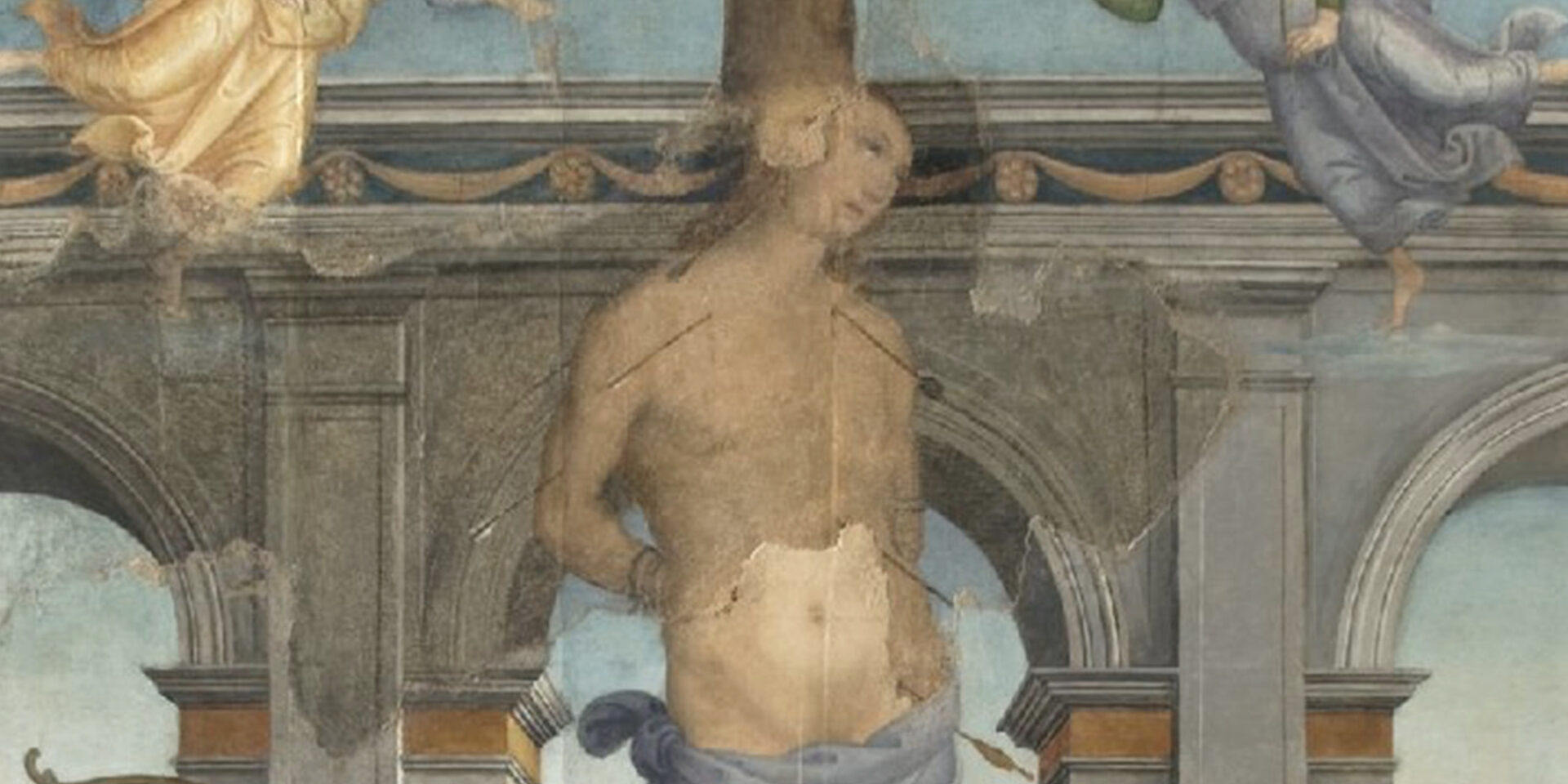
In its turn, the National Gallery loaned the Martinelli Altarpiece – originally made for the Church of Saint Francis al Prato, Perugia – to the St. Lawrence Island for an interesting event. Starting from March 20, in fact, in the room called Sala del Dottorato in the cathedral’s cloister, the Martinelli Altarpiece will be restored live. Painted by Perugino, it shows the martyrdom of Saint Sebastian. It had been commissioned in March 1505 by Giovanni and Sinibaldo Martinelli in memory of their father. Perugino, however, would just fulfill the job thirteen years later, after a long litigation. The date of completion is written on the frieze of the pedestal on which the pillar and Sebastian’s feet lie.
Restoration, which will now be carried out by CBC experts (a society dealing with art restoration and preservation), was absolutely needed because of the altarpiece’s bad state after having been shifted more than once from one place to another in the original church.
The event, that has a strong educational significance, will allow viewers to watch and learn the skills and techniques of art restoration via a full immersion in the atmospheres of a Renaissance workshop, and Perugino’s lifestyle. It will also make it possible to take a closer look on the history of art preservation, as well as the development of its techniques.
The Marriage of the Virgin and other works by “the best master in Italy” come back to Perugia
The Perugino Exhibition has a national and even international horizon. In addition to providing a chance to eyewitness the restoration of the Martinelli Altarpiece, it will also allow visitors to admire a selection of Perugino paintings from other Italian museums, and farther than that. Among the many works on display, you will see Virgin Mary and the Christ Child, with the Saints John the Baptist and Sebastian; the Pietà (and the Saints Nicodemus, John the Evangelist, Mary Magdalene, Joseph of Arimathea); and The Prayer in the Garden of Gethsemane, loaned by the Uffizi Gallery, Florence. And moreover, the Polyptych of the Pavia Charterhouse, from the Charterhouse Museum, Pavia. The Scarani Altarpiece, from the National Art Gallery in Bologna. Virgin Mary with the Christ Child and angels, between the Saints Rose and Catherine of Alexandria has arrived from beyond the Atlantic Ocean, i.e. the National Gallery of Art in Washington, DC. Finally, one of Perugino’s most famous paintings, The Marriage of the Virgin, has been loaned by the Museum of Fine Arts in Caen, France.