
The Fortress Guarding Assisi
Squilla la tromba che già il giorno finì,
già del coprifuoco la canzone salì.
Su, scolte, alle torri,
guardie armate, olà!
Attente, in silenzio vigilate!
Attente o scolte, su vigilate!
The trumpet sounds, the day has ended;
the curfew song rises through the air.
Up, sentinels, to the towers,
armed guards, ho there!
Be watchful, in silence keep your vigil!
Be watchful, sentinels, on guard!
The Inno delle Scolte di Assisi (Hymn of the Sentinels of Assisi) is a fourteenth-century composition of unknown authorship. As one reads its verses, it is easy to imagine the echo of trumpets summoning the townspeople of Assisi within the city walls at the approach of the nightly curfew. In the Middle Ages, sentinels, known as scolte, kept watch over the territory from the towers and walls of the Rocca di Assisi, the fortress that has dominated and protected the city for more than eight hundred years.
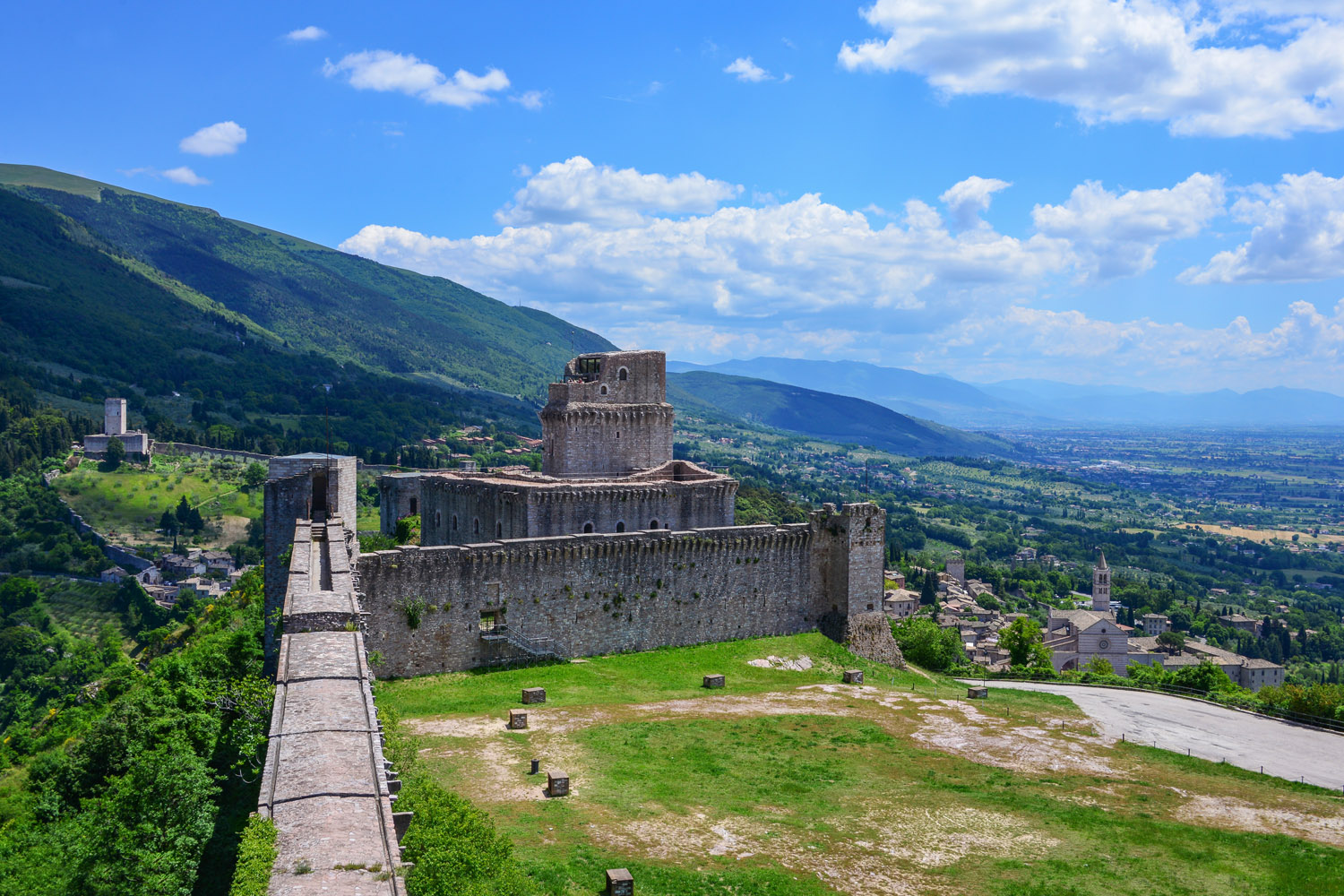
Rocca Maggiore and Rocca Minore
The Rocca Maggiore of Assisi, built of the pink limestone characteristic of Monte Subasio, rises on a hilltop long frequented for its commanding view over the surrounding landscape. The first documentary evidence concerning its medieval phase dates to 1174, when Cristian, Archbishop of Mainz, seized the city in the name of Emperor Frederick Barbarossa, who himself visited Assisi only three years later. Conrad of Urslingen, a member of the Swabian dynasty and former Duke of Spoleto, received the title of Count of Assisi in 1177 and took up residence in the Rocca Maggiore. Later, Henry VI, son of Barbarossa, and his wife Constance of Altavilla entrusted their heir, Frederick II of Swabia, to Conrad and his wife. The future emperor is believed to have spent part of his youth in Umbria, particularly between Assisi and Foligno. In 1198, a popular uprising in Assisi against the German imperial rule led to the destruction of the fortress. It was, however, rebuilt around 1360 by Cardinal Egidio Albornoz, who had been charged by the pope with restoring papal authority in the territories of central Italy in preparation for the return of the papal court from Avignon to Rome. It was under Albornoz that the Rocca Maggiore and the Rocca Minore were united into a single defensive complex by means of a walled enclosure that still today winds through, and merges with, the houses of the Porta Perlici and Porta Cappuccini quarters.
The Rocca Minore, considerably more modest in size than its counterpart, was built to guard the road leading toward the Marches and the route ascending Monte Subasio.
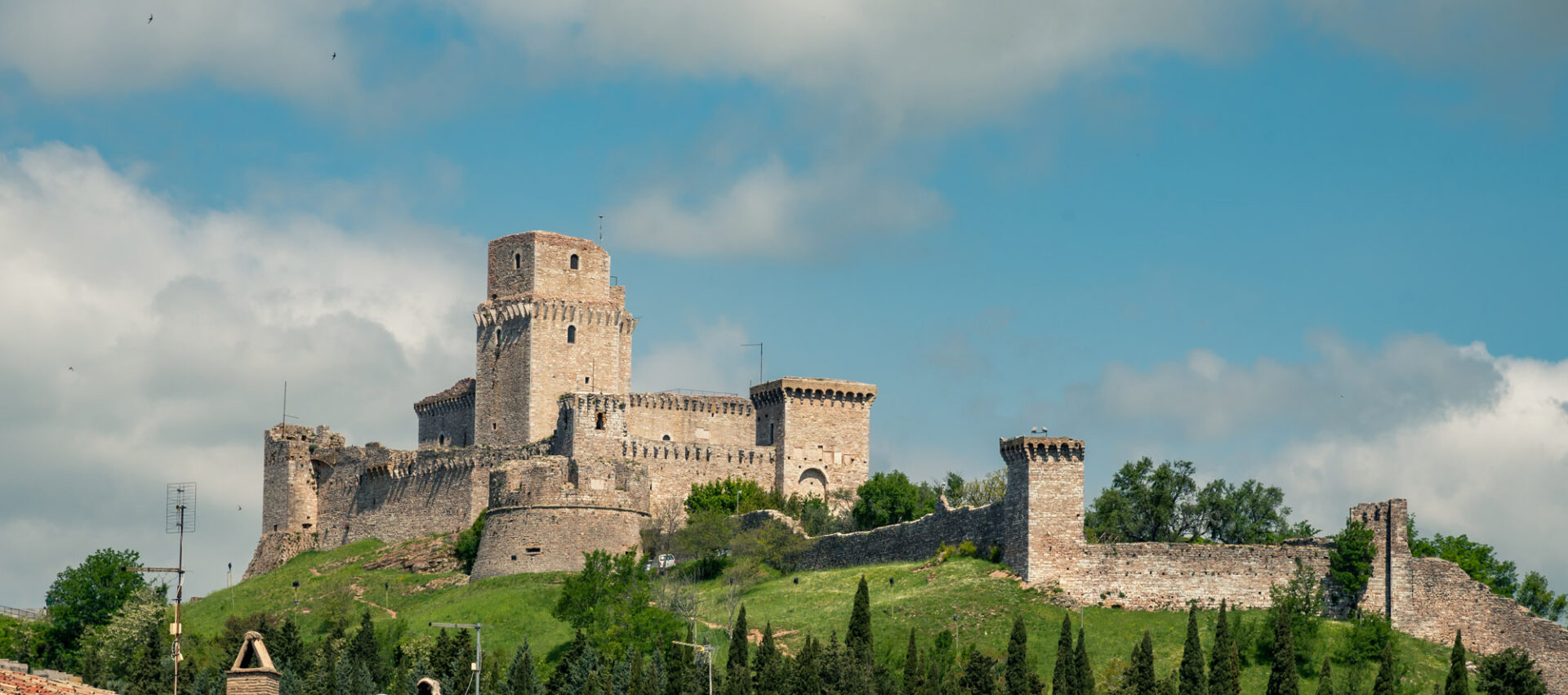
The Expansion of the Rocca Maggiore
From the fourteenth century onwards, the Rocca Maggiore became a potent symbol of external domination over the city of Assisi. In 1395, Biordo Michelotti, lord of Perugia was the first of a succession of condottieri who held sway over Assisi. He ordered the raising of the maschio, the principal and tallest tower, thereby giving the fortress an even more imposing and martial appearance. In 1458, Jacopo Piccinino added the polygonal western tower, later completed by Pope Pius II Piccolomini, who constructed the elevated passageway connecting it to the main fortress. Finally, in 1535, Pope Paul III Farnese commissioned the building of the circular bastion, whose rounded shape was designed to deflect and absorb the impact of artillery fire. In 1543, Pope Paul III had the cannons of the Rocca Maggiore transferred to the Rocca Paolina in Perugia, erected by his order after the so-called “Salt War,” in which he defeated and expelled the ruling Baglioni family. From that year onwards, the fortress of Assisi lost its military function, serving henceforth only as a prison. This marked the beginning of a long period of decline, during which its furnishings and building materials were stripped away. It was not until 1891 that restoration work began on this monument, which today is open to the public and hosts exhibitions as well as summer events, including concerts and open-air film screenings in the outer courtyard of the Rocca Maggiore.
From the esplanade of the Rocca Maggiore one can enjoy a breathtaking panorama of Assisi, the wide valley below, and, in the distance, the rolling hills surrounding Perugia. The view is particularly evocative at dawn and sunset, when the green Umbrian countryside is suffused with warm, golden light.